


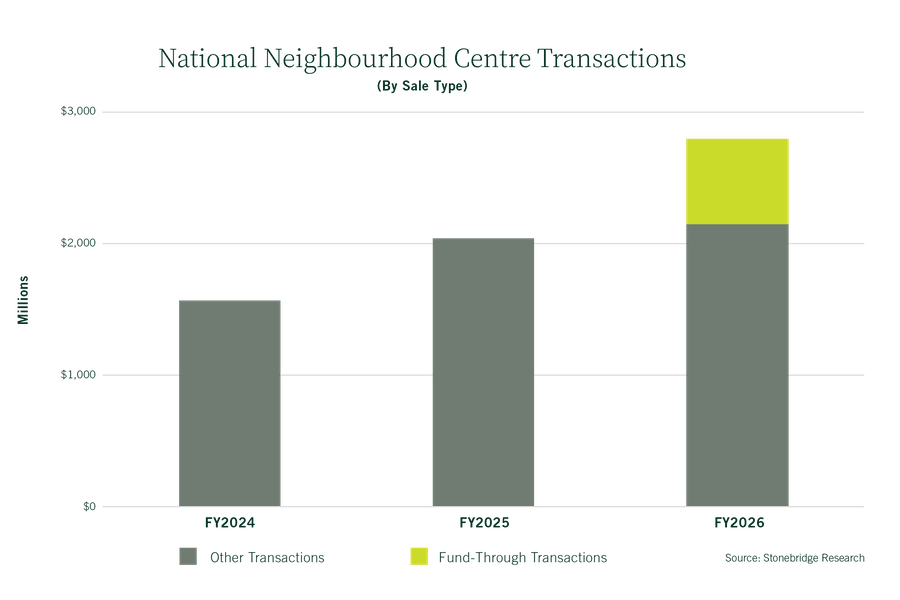
Fund-through capital has gone from almost nothing to more than $600 million in a single year. In FY26, the structure accounted for roughly 23 per cent of all neighbourhood shopping centre investment activity – after several years of virtually none – as investors move earlier to secure scarce retail assets before they reach the open market.
From fallback to strategy
Stonebridge Retail Investments says the structure, historically associated with large institutional developments, is becoming increasingly common across neighbourhood shopping centres, large format retail centres and other essential retail assets. Rather than relying solely on a traditional development-and-sell model, developers are increasingly partnering with investors before completion to reduce exit risk, improve funding visibility and provide greater certainty around project delivery.
The shift has coincided with a significant increase in investor appetite for development-stage retail assets. Stonebridge’s latest Neighbourhood Centre National Update found fund-through transactions accounted for approximately 23 per cent of neighbourhood shopping centre investment activity during FY26, representing more than $600 million of transactions after several years of essentially no activity.
Stonebridge Retail Investments national partner Justin Dowers said the growth of fund-through structures reflected a greater alignment between the objectives of developers and investors.
“Fund-through transactions are increasingly becoming part of the development strategy rather than an alternative exit mechanism,” Dowers said.
“For developers, securing capital earlier can provide significantly greater certainty around funding and the ultimate project exit, while allowing capital to be redeployed into new projects sooner. For investors, it provides the opportunity to secure high-quality assets before they are completed and exposed to a much broader buyer pool.”
Proof in the transactions
That alignment has become increasingly evident through several major transactions completed over the past 12 months. Earlier this year, Stonebridge Retail Investments advised on the circa $300 million Oreana Neighbourhood Centre portfolio, acquired by IFM Investors in partnership with Fawkner Property.
The portfolio comprised four Coles-anchored neighbourhood shopping centres across Melbourne’s growth corridors: Botanical Village, Deanside Central, Riverwalk Town Centre and Eynesbury Village. At the time of the transaction, Botanical Village had been completed, while the remaining three centres were either under construction or preparing to commence construction.
The transaction represented one of Australia’s largest neighbourhood shopping centre fund-through portfolio deals and demonstrated the willingness of major institutional capital to commit to assets well before completion where there was confidence in the development fundamentals.
“The Oreana transaction demonstrated how institutional capital can work alongside developers to facilitate the delivery of high-quality retail projects,” Dowers said.
“Rather than waiting until each centre was completed and stabilised, the investor was prepared to commit capital during the development phase because of the strength of the locations, the Coles covenant and the long-term population growth supporting the respective catchments.”
Why developers are signing up earlier
The circa $500 million Woolworths neighbourhood shopping centre portfolio transaction, which included a partial fund-through component, provided further evidence of institutional capital moving earlier in the development cycle.
The increasing use of these structures comes as developers continue to navigate an environment where construction costs, financing conditions and project timing can materially influence development outcomes. Against that backdrop, securing an investor earlier in the process can provide greater confidence around the funding and delivery of a project while reducing exposure to market conditions at the point of completion.
Why the supply squeeze is driving it
For investors, constrained access to high-quality retail opportunities is also driving greater interest in fund-through structures, particularly across the neighbourhood shopping centre sector. Stonebridge Research indicates only around 32 per cent of neighbourhood shopping centre transactions were publicly marketed during FY26, while more than $1 billion of stock has been removed from the available investment space over the past two years through major direct portfolio acquisitions.
This constrained supply is encouraging investors to engage with developers earlier, particularly for projects in high-growth markets where completed assets may attract significant competition or remain tightly held once delivered.
The supermarket shortfall
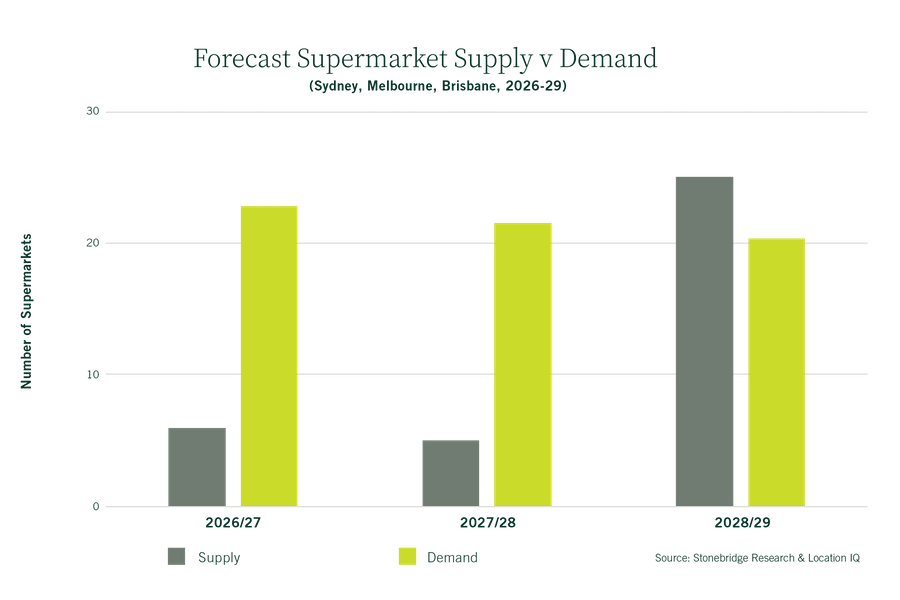
Population growth is also creating a need for continued investment in new retail infrastructure. Across Sydney, Melbourne and Brisbane, approximately 65 additional supermarkets are forecast to be required over the next three years, while only 36 new neighbourhood shopping centres are currently forecast for delivery. This implies a potential shortfall of approximately 29 supermarkets and reinforces the need for capital to support the delivery of new projects in rapidly expanding markets.
A genuine win-win
Dowers said the combination of constrained investment supply and the need for new retail development was likely to drive further growth in fund-through and forward commitment structures.
“Fund-through structures can create a genuine win-win outcome. Developers gain greater funding certainty and reduced exit risk, while investors can secure scarce, investment-grade assets before they reach the broader market.
“As competition for high-quality retail investments continues and developers seek greater certainty around project delivery, we expect these structures to become an increasingly important part of how new retail assets are funded and transacted.”
Stonebridge Retail Investments is currently advising on a number of fund-through and forward commitment opportunities nationally across neighbourhood shopping centres and other retail developments.
The continued growth of these transactions points to a broader evolution in the retail development market, with capital increasingly being introduced earlier in the project lifecycle. Rather than viewing development funding and investment sales as separate stages, developers and investors are increasingly bringing the two together to create greater certainty around the delivery and ownership of Australia’s next generation of retail assets.

Add comment