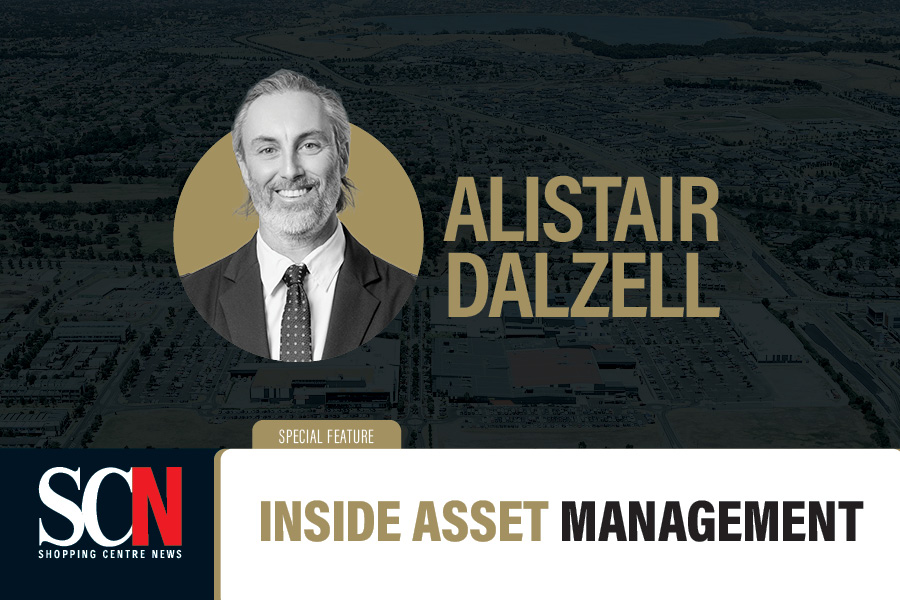
With a career spanning construction, development and out-of-home media before moving into retail property, Alistair Dalzell brings a diverse perspective to his role as Head of Asset Management – Core Real Estate at MA Financial. Overseeing a portfolio of more than 35 shopping centres across Australia, Alistair discusses the fundamentals of successful asset management, the growing importance of repositioning existing assets, and why the smallest details sometimes deliver the biggest results. Sh
opping Centre News (SCN):How did you get started in retail property, and how has your career evolved?
Alistair Dalzell (AD): Thanks to my brother-in-law and countless coffees with contacts in the industry, my journey did not follow the usual path of an analyst or centre-management route. After working in several industries (construction, development and out-of-home media), and having what felt like coffee No 150, I landed a role at QIC as the innovation manager, which is a fancier way of saying new revenue manager. I put this down to a varied skillset and the drive to get on the landlord side. After an internal secondment, some great senior leaders, and time in a supportive environment, I landed an investment manager role.
Over the years, I transitioned from JV asset management to 100 per cent owned assets, moved from QIC to IP Generation (now part of MA Financial Group), and due to some great senior leaders, I continue to grow into the role of Head of Asset Management for MA’s Core Real Estate team.
SCN: What types of assets do you currently manage and what are your priorities?
AD: At MA Financial, we are responsible for more than 35 shopping centres across Australia, ranging from main street retail through to super regional centres with large peripheral land holdings. I am responsible for overseeing the performance and strategic direction of these assets. Key responsibilities for me and that of my broader team are to set the long-term strategy for each asset and to identify opportunities to enhance performance and create value over time.
Ultimately, our focus is on delivering strong, sustainable outcomes for our investors while ensuring our assets continue to meet the needs of the communities they serve.
Top Ryde City, NSW
SCN: What do you enjoy most about asset management, and what continues to motivate you?
AD: I enjoy working with and learning from the wide breadth of stakeholders in our industry. In asset management, we are fortunate to have three key clients – our investors, our retail partners and customers visiting our assets. I am motivated to understand what drives our clients’ needs and to implement the strategy to deliver on these.
SCN: What are the biggest priorities when managing a successful retail asset in today’s market?
AD: In our view, the fundamentals of managing a successful retail asset include maintaining a relevant retail mix, supporting strong retailer performance and delivering an experience that gives customers a reason to keep returning.
At the same time, disciplined cost management is critical. Ultimately, it’s about balancing investment and operational efficiency to ensure the asset remains relevant and competitive, and delivers sustainable long-term performance.
SCN: How has the role of an asset manager changed over the past five years?
AD: I don’t believe the fundamentals of the role have changed significantly, but the environment we operate in has. With wider macroeconomic influences limiting the development of new retail space, we’ve had to become more strategic in how we unlock value and deliver our objectives within the existing asset footprints.
SCN: How do you balance convenience and customer experience when making asset management decisions?
AD: Convenience is the foundation of a positive customer experience. Easy access, parking, wayfinding, safety and essential services must work seamlessly. Offerings such as dining, entertainment, events and quality public spaces provide additional reasons to visit, stay longer and return.
Hyperdome, QLD
SCN: What metrics do you look at beyond sales and occupancy when measuring the success of a centre?
AD: Visitation growth and basket size are key metrics beyond sales and occupancy to understand and drive the success of a centre. We need to understand how these metrics are tracking in line with sales, as they are fundamental to the success of our retail partners and, therefore, the occupancy of our assets. If these metrics are not growing, we then take a deeper look at the customer sentiment of the asset and implement targeted strategies to turn this around.
SCN: What are the most significant opportunities currently emerging across the retail property sector?
AD: As noted earlier, with limited new GLA, the most significant opportunities in retail involve repositioning assets to ensure they continue to meet evolving community needs. We seek to achieve this through mixed-use development. This can include health and wellness, entertainment and improved public spaces, which, in turn, create more resilient assets.
SCN: What’s one initiative – large or small – that delivered an unexpectedly positive outcome for one of your assets?
AD: A sales report audit on our tenants was a very small, yet hugely beneficial initiative. We discovered some incorrect reporting, which when fixed, resulted in a nice back payment, rent reset, and a material increase to the asset value. The devil is in the details.
SCN: How do you build strong, long-term relationships with retailers and other stakeholders?
AD: The key is to understand their objectives. Once you understand these, you can continue to build on the relationship through regular communication and a willingness to work collaboratively. This is the part of my job that I enjoy the most.
Craigieburn Central, VIC
SCN: How do you approach capital investment and asset repositioning to ensure long-term value creation?
AD: Each asset is different. Some need to improve the customer experience, some need retailer remixing, while others need lifecycle focus. You need to have a clear overarching strategy for the asset. This will then guide how and when you spend your capital, which then can be clearly communicated to the stakeholders.
SCN: Is there a retail asset or precinct – either in Australia or internationally – that you admire? What makes it stand out?
AD: I’m a big fan of the James Street precinct in Brisbane. It is a great experience, which is a result of the beautiful design and the great mix of retail, accommodation, entertainment, health and wellness. It’s cool to see what a number of individual owners that all operate with a shared vision can achieve. It’s only going to get better.
SCN: What advice would you give to someone starting a career in retail asset management today?
AD: Retail asset management has lots of different areas that require a number of different skill sets. Identify what your skill set is or what you enjoy doing, lean into that part of asset management, and then work closely with others who complement your skills and strengths. Be inquisitive because no two days are the same. Network, reach out to your peers from other businesses, and keep learning.
This Q&A with Alistair Dalzell forms part of the Inside Asset Management feature published in the latest issue of SCN magazine





Add comment