



I’m sure we’ve all been affected in some way this summer by the endless havoc we’ve seen with the fires, followed by potential flooding in areas and now a global viral epidemic. It certainly makes me, and I know through conversations, many of us, incredibly more focused on what is important, including the need to reconnect and nurture in order to preserve, and hopefully thrive.
A sustainable future
Reflecting on the contributions of the amazing volunteers, the essential services teams and the incredible generosity of not only Australians but also global citizens, it causes you to pause and ask what is the legacy of our industry?
What is our purpose? This is worth exploring as purpose is at the very heart of relevancy for any business that wants to engage with a thoughtful and progressive audience. We have seen this clearly play out in retailing brands and it will play out in our assets, as the most progressive partners and customers will seek to understand our commitment to the environment and to society.
Mirvac set some ambitious goals when it launched its sustainability strategy called ‘This Changes Everything’ in 2014. Our CEO Susan Lloyd-Hurwitz said at the time – “The future depends on us acting in a sustainable way and thinking creatively about how we impact our environment and our communities”.
We made an industry-leading commitment to achieve a goal to be net positive in carbon emissions by 2030, and in 2019 we released our plan on how we’ll achieve our target. One of the key steps in achieving this ambition is by maximising energy efficiency and transitioning to 100% renewable energy. Within the Retail business we’ve made some major inroads in this area, reducing our carbon intensity by 34% across the portfolio in six years, primarily through reducing electricity consumption. Carbon emissions will be further reduced as we have committed to a new three-year energy contract to procure 100% renewable electricity to 80% of the retail portfolio and the remaining 20% of the portfolio by the end of 2020.
Retailing and the provision of physical space, is an industry that relies on consumption to thrive – so how can we be more responsible in this consumption?
A key focus as space managers is on reducing landfill waste. For example, as a portfolio, when we deliberately upweighted to an enhanced food and beverage tenancy mix, we wanted to work through how to deal with our increased organic waste.
In 2019, our portfolio of retail assets diverted more than 3,500 tonnes of organic waste from landfill. Organic waste is a valuable material that can be donated to local farmers and their communities or collected and processed into a high-quality compost at a licenced facility.
Mirvac has also invested in nine on-site PulpMaster systems that process the organic waste into a liquid that is then collected and processed into soil enrichment products. Last year, Kawana Shoppingworld and Orion Springfield Central purchased more than $2,500 of the compost back and donated it to local farmers and gardens, achieving a sensational closed loop initiative.

Our mindset is about moving towards the value of a circular economy on our journey to send zero waste to landfill by 2030.
Our future relies on how we act and contribute to society. We succeed when the communities we operate in thrive.
Connected urban hubs
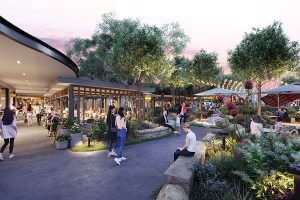
It is our belief that the power of the urban place is in its physical connectivity. With more than 120 million visitations across a relatively modest GLA footprint, our venues play an important part in urban living. These connected urban hubs can broaden their place within their communities – with the space, the parking, the distribution capability, and the proximity to so many and varied activities and uses, creating an opportunity well beyond a collection of shops for consumers.
Mirvac’s assets offer a highly valuable audience to new partners, who are seeking connection to a highly progressive consumer audience – early adopters who are often at the forefront of societal and technological trends.
This gives us enormous opportunity to attract the most progressive partners, including:
• The recently opened Cirque Electriq bar and gaming parlour in Toombul, Brisbane (part of the Archie Bros Group) – a first to Queensland concept;
• Cook with Costi – a fresh and cooked produce collaboration between two of the country’s best butcher and seafood operators;
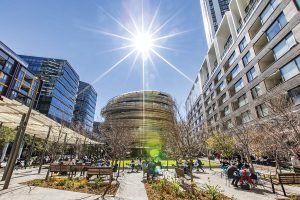
• Kylie Kwong, one of Australia’s most renowned chefs, who will be our precinct ambassador for South Eveleigh, with a strong focus on bringing people together to create a new community that authentically acknowledges and embraces the strong history of the precinct; and
• Our recently announced partnership with Live Nation, one of the leading entertainment providers in the world, recognising the value of existing urban infrastructure in facilitating large-scale events and their ability to transform our assets into dynamic venues.

Embracing progressiveness
In a rapidly changing retail landscape, we believe the customers that are the most embracing of innovation and disruption are in fact the most valuable in attracting progressive partners today, with this set to accelerate in the future. This plays across the generational divide today in urban markets.
These consumers have:
• Prosperity and wealth;
• And importantly a propensity to spend;
• The potential to grow in value; and,
• Are progressive in their attitudes, as early adopters of key social, cultural and technology trends
These consumers also significantly over-index in spend across key growth categories of Health and Wellbeing, Entertainment and Leisure and Education, as well as the growing ‘edu-tainment’ phenomenon. As early adopters, they are generally more open to trying new products and experiences and can be considered thought leaders who thrive on innovation. Mirvac has two-and-a-half times more exposure to these customers (compared to the Australian average), as they typically live in inner-urban locations.
This has led to significantly higher online sales penetration in our markets (some 27% higher in December 2019), due to an early adoption of technology trends.
Despite this online growth, our portfolio has seen positive sales CAGR of 3.8% since 2016.
This is contrary to the traditional view that ALL online retail is a threat to ALL physical retail. We know that the advanced and progressive retailers understand the value of the interplay between online and physical, seeing the immediate benefit to online sales growth when complemented with the physical.
Eric Nordstrom, Co-President of Nordstrom’s Department store, recently outlined (at NRF) how their business cases for stores has evolved. They recently opened their first all ladies department store in NYC, which is currently their best performing online market – “The stores’ role isn’t just about what’s rung up within the walls, (but) we also get an uplift in our online sales when we add a store to the market. More than half of Nordstrom sales have a digital component, and over one third of online experiences have a store element”.
In today’s world, when businesses are born to an online world well before they have any physical presence, brands have incredible information, insights and understanding of their customers through their online communities. With great examples in the US (think Warby Parker, Bonobos, Casper and Rent the Runway) of digital native retailers continuing to grow their store networks, it’s logical that brands will want to physically be where their online customers are in order to truly thrive in our new multi-modal world where customers demand and value multiple touch points across any purchasing journey.
Additionally, non-retail partners also value the exposure to progressive audiences, and we see this as an area of growth for our assets in the future, seamlessly integrated to, importantly, amplify our retail uses.
A new dawn – and a new decade…
We are in an industry that at its simplest form, provides space but well over 95% of this ‘space’ was built in the 20th century. That is one big legacy drag!
Nordstrom’s has traded for over a century, in a category that has continued to see its demise globally in slow motion for more than 20 years. However, Nordstrom’s has continued to reinvent and to recognise that while ‘retailers need to have tech intensity’, ultimately, it’s about creating a great experience (like an awesome champagne bar in their shoe department) for their customers. “I’ve never heard a customer use the word channel with me – those lines are completely blurred”.
To remain successful in our industry, I thought Eric Nordstrom summed up brilliantly – “we want to be the partner of choice for brands in order to stay relevant to the modern customer – we want a place that curates the greatest brands in the world. As these dynamics in our industry change there’s a consolidation on both the supplier and the retailer side, it continues in importance for us to be the retailer of choice for these brands. To be the best partner takes a level of flexibility to be that partner of choice and make sure it’s a great experience for these companies. Doing so helps us become a place that people come to for newness and discovery of brands.” We have a lot in common!
And my final quote from Eric sums it up nicely – “The most common downfall for retailers and for brands is getting old with your customers…” I feel the winds of generational change in our industry and it is becoming increasing apparent that to survive we must all continue to evolve.
In closing, I’m optimistic about the future. While we focus on all the disruption and innovation occurring within our retail industry, the events over summer illustrate that everything is being disrupted. It challenges us to constantly come up with new ways to ensure our industry makes a positive contribution to the environment, including our social contribution, and in reimagining what great retail can be…

About Mirvac Retail
Mirvac Retail owns and manages a dynamic portfolio of shopping centres across Australia’s eastern seaboard with total assets under management of more than $4.5 billion. Incorporating over 440,000m2 of retail space and more than 1,600 retailers, Mirvac’s centres have strong positions in their local markets with geographic, retail and economic diversity. The centres are individually branded, marketed and positioned to suit the specific needs of its customers in each of their unique catchment areas.

Add comment