



Liveability
liv•a•bil•i•ty [liv-uh-bil-i-tee]
noun
The term that describes the ‘human element’ of sustainability. It refers to the wellbeing of a community and represents the characteristics such as health, sense of safety, access to services, mobility and social participation – that combine to make a place one where people want to live now and in the future.
Retail is constantly evolving, and in 2018 it will be no different. In the year ahead we will be focusing on what matters most to our customers and our communities – human connection, health and wellbeing and convenience.
Each year at Stockland we conduct the Liveability Index, surveying more than 2500 residents across 40 communities in Australia. It provides us with insights on what matters most to residents and what they want in their local communities at different stages of their lives.
We know from the Index liveable cities are those that are connected, healthy, smart and affordable. This helps us in designing our communities and our town centres to ensure we are creating places that improve the lives of our customers.
To me personally, liveability is important in understanding how our centres can improve people’s lives through becoming the heart of the community.
I love seeing people choosing to cycle to the shops and using end of trip facilities, making the cafe at their neighbourhood centre the meeting place for their mothers group or knowing their butcher by name. These small things can have a profound impact, creating opportunities for community interaction and ultimately leading to improved wellbeing. In 2018 I don’t think there is anything more important than that.
Focusing on health and wellbeing
The Liveability Index measures the wellbeing of our customers via a Personal Wellbeing Index. Results show the average shopper in a Stockland retail centre has a Personal Wellbeing Index score of 73%. Interestingly, those shoppers who participate in our Heart Foundation Walking groups achieve a wellbeing score of 77%. This demonstrates the direct, positive impact of community health and wellbeing programs.
Across our 40 shopping centres nationally from as far north as Cairns to as far west as Baldivis we are looking for ways to positively influence the health and wellbeing of our customers.
Earlier this year we celebrated the success of our Jamie’s Ministry of Food kitchen at Stockland Wetherill Park. Since opening in 2015, more than 6,700 people have completed the Jamie’s Ministry of Food seven-week course at Wetherill Park, learning basic cooking skills and Jamie’s hints and tips, to be able to cook healthy nutritious meals from scratch using fresh food.
Many people directly changed their lifestyle and eating habits following participation in the course, with a total 24,000 additional cups of fruit and vegetables consumed every week and participants stating that they felt more confident cooking meals from scratch and spent less on takeaway foods.
Watch this space as you will see more focus on health and wellbeing programs over 2018 and beyond.
Creating inclusive places
Our communities and town centres across Australia should be accessible to all people.
Together with the Touched By Olivia Foundation we have opened six inclusive playgrounds across our shopping centres nationally with many planned for the coming years. These playgrounds are designed to encourage all children to play together, including those with physical disabilities, vision, hearing and mobility impairments, or spectrum disorders such as autism.
We believe it is important to help alleviate the barriers experienced by Australians with a disability and we see these playgrounds as not only a destination for our customers but a place where all children can let their imaginations run wild and enjoy playing together.
Big environmental targets
We are also focused on improving our environmental footprint across our retail centres. Last year we announced a $23.5-million investment to install Australia’s largest retail solar roll-out across 10 shopping centres. We are now well underway with this piece of work connecting more than 39,000 Photo-Voltaic (PV) panels, comparable in size to more than nine rugby fields, in areas such as Merrylands, Burleigh Heads, Point Cook and Wendouree.
Investing in technology like solar energy is not only environmentally sustainable, it also makes good business sense, and we are extremely proud to be setting a new standard in solar for Australian property which will help create clean, green energy for our retailers, our customers and the communities we operate in. We’re looking forward to more opportunities to incorporate solar across our commercial property portfolio.
Experiences not stuff
Another way our retail centres are shifting in 2018 is the growth of retail services and experiences.
Increasingly, shopping centres are becoming more diverse in their offering for customers. If you go back 35 years, services such as the doctor, dentist, physio, child care and the gym were all located on our main streets. Now they’re coming into the mall.
In our Stockland town centres today, 18% of gross rent in our portfolio is apparel (kids, men’s, ladies, unisex, surf wear) and jewellery. Comparably, 18% of gross rent also goes specifically to services.
While certain categories of retail are being challenged with globalisation and the growth of online shopping, services are a very resilient category to these external changes.
At that heart of this shift is the focus away from people wanting ‘stuff’ and instead yearning for experiences. This shift actually provides a competitive advantage both for the landlord and the retailer as we see the upward trend of dwell time and engagement from the customer.
We have seen this following our $228-million redevelopment of the Stockland Wetherill Park Shopping Centre in Western Sydney. Creating activated casual dining precincts and greater entertainment offerings visitor numbers have increased significantly and now sit at approximately 7.6 million (MAT) annually.
Twenty years ago we would have been unlikely to see this kind of engagement at a local suburban shopping centre but as our cities grow, particularly in Sydney we choose to stay local rather then travel to the CBD for experiences – and why not when they are available in our backyard?
Last year, Stockland partnered with the Australian Museum to bring an ultra-realistic 11-metre-long, 3-metre-tall T. rex model on tour to Stockland Wetherill Park in Western Sydney, Stockland Shopping Centres in the Illawarra, Forster on the mid-North Coast, and Glendale in the Hunter Region.
This offered customers an intimate dinosaur experience, never before seen in Australia and certainly unique for a shopping centre outside of the CBD.
We are constantly looking for ways to bring unique, fun and educational entertainment and experiences to the 422,000 customers who visit our 40 Stockland shopping centres across Australia every day.
The future – converting shopping centres into town centres
The father of the American shopping mall, Victor Gruen built his first shopping centre in Detroit in 1954. Unlike so many of the fully enclosed malls that followed, and that we know today, the two-million square foot centre he first created included outdoor space, auditoriums, a bank, a post office, local retailers and a supermarket.
It was an early example of urbanism, bringing together experiences, services and public places together. It is exciting to see that this pioneering vision is beginning to be realised, particularly as our capital cities become more urban and we value what a town centre can offer.
The future of shopping centres will be much more than just services and experiences. It will be the evolution of the shopping centre as we know.
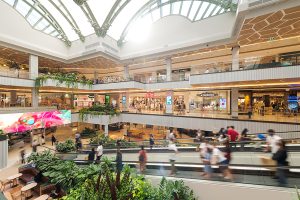
Over the next decade the mall will increasing transform offering customers mixed-use town centres combining residential, retail and community spaces together and offering activated indoor/outdoor spaces.
We are already seeing this evolution within our portfolio particularly in our new mixed-use communities.
At Stockland’s Birtinya community at Oceanside on the Sunshine Coast, we have commenced development of the $830-million Birtinya Town Centre masterplan development.
Across an area of 18 hectares, we will build a lifestyle shopping centre with an oasis feel, a new civic plaza, walkable waterfront and open green space – all integrated with commercial, health related research facilities and high density residential. This development brings to life the future of retail culminating in a shared vision for a vibrant mixed-use precinct for residents, retail and the wider community.
Upon completion the Birtinya Town Centre will become a true people’s place, with lifestyle amenity for the community now and into the future – a place that connects people for business, shopping, dining and fun.
At Stockland our long-term goal is to see this evolution across our entire retail portfolio.
From low-scale changes like adding a dining precinct at Stockland Bundaberg to the large scale $414-million redevelopment of Stockland Green Hills in East Maitland, redefining retail for the Hunter region as we transform it into the premier retail, entertainment and dining destination. To us, it is about creating retail amenity, employment opportunities and a place for the community now and into the future.
At the end of the day, it’s our job to make sure we’re creating the best environment for a retailer to transact and the best possible place for a customer to visit and shop and in 2018 we are focused on ensuring we deliver just that.
WATCH TIM BEATTIE SPEAK AT THE BIG GUNS LUNCH
About Stockland
Stockland is one of the largest diversified property groups in Australia with more than $16.6 billion of real estate assets. As Australia’s largest community creator, Stockland own and manage 40 retail town centres, 27 logistics centres and business parks, 8 office assets, 56 residential communities and 65 retirement living villages.
Founded in 1952, today Stockland leverages its diversified model to help create thriving communities with dynamic town centres where people live, shop and work. Our vision is to be a great Australian real estate company that makes a valuable contribution to our communities and our country.

Add comment