


This year has been a defining one for shopping centre transactions and capital appetite for the sector. Several years of improving asset and investment fundamentals have fueled strong appetite from global capital.
Year-to-date retail transaction volumes are above $10 billion and tracking 12 per cent and 25 per cent above the prior five- and 10-year averages, respectively. Despite this activity, high-quality assets have been hard to access, particularly at the larger end of town, in what has been a record year for off-market deals.
Off-market activity up across all high-value sub-sector trades
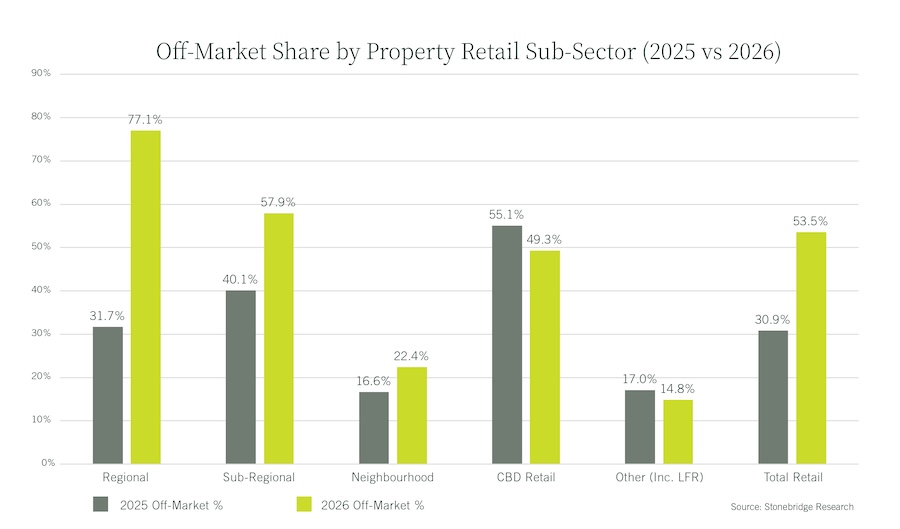
Formal (on-market) supply of high-quality retail assets remained subdued throughout 2026, with the off-market share of deals rising to 53.5 per cent, up from 30.9 per cent in the prior year.
The pool of capital targeting retail has become increasingly diverse over the past 24 months. The rise in off-market shopping centre transactions highlights both the depth of this capital and confidence in pricing (book valuations) through 2026. The trend has been most pronounced among larger, higher-value centres, with Regionals, Sub-Regionals and CBD centres all recording elevated levels of off-market activity.
Sam Linden, director of retail investments Australia and New Zealand at Stonebridge, said: “Global capital has transitioned from education to deployment within the Australian retail sector. The run of transactions over the past two years has provided greater deal certainty and driven a rise in off-market activity, ensuring both vendors and purchasers are satisfied on price and terms. However, should the market dislocate into the new year, we would expect the off-market share of transactions to fall back toward longer-term averages as vendors seek pricing clarity via formal on-market processes.”
Our data shows that across all 2026 transactions, the yield differential between on- and off-market deals is just 6bps. This is evidence of a tightly priced sector and reinforces confidence in book valuations, with narrow bid-to-ask spreads allowing off-market deals to proceed. However, this confidence is starting to be tested by an increasingly volatile global environment and rising debt costs.
Why buyers seek off-market transactions
Buyers pursue off-market transactions – and often prefer them to a formal on-market expression of interest (EOI) campaign – for several reasons:
- Elimination of competition: Despite recent statistics not substantiating such fears, buyers still typically prefer off-market deals to avoid bidding wars that can escalate pricing (which would otherwise benefit the vendor) and can improve the chances of securing the asset by removing counterparty risk (a rival lifting its bid or improving terms).
- Proprietary deal flow and alpha: Off-market acquisitions can enhance a group’s reputation for deal-making, showcasing its local network, market intelligence and relationships. A strong track record of securing assets off-market can also strengthen a group’s ability to raise new capital.
- Deal and negotiation flexibility: Whilst not typical, some off-market deals can offer considerable flexibility when dealing with motivated vendors who need a quick process or greater deal certainty and are prepared to concede terms that favour the buyer (such as adjustments to pricing, timing or capital-related items).
- Privacy and confidentiality: With fewer parties involved, confidentiality is easier to maintain – a major advantage for groups that do not want competitors, the media or the public knowing their financial moves.
Strategic considerations on the sell-side
Whilst off-market divestments can also offer vendors numerous benefits, the key strategic trade-offs on the sell side are the loss of:
- Competitive tension that can lead to price maximisation and/or better terms.
- Timing pressure that can prompt buyers to act decisively and place less weight on certain asset or deal-related issues.
- Fiduciary protection, as a competitive process removes any second-guessing over whether the best price was achieved.
- An ability to pivot back to underbidders should a party not complete the transaction.
Whilst some groups also prefer off-market for deal anonymity, a sole agency appointment can often provide greater control over messaging and confidentiality vs. an open agency off-market approach.
The capital sources that preferred off-market activity in 2026
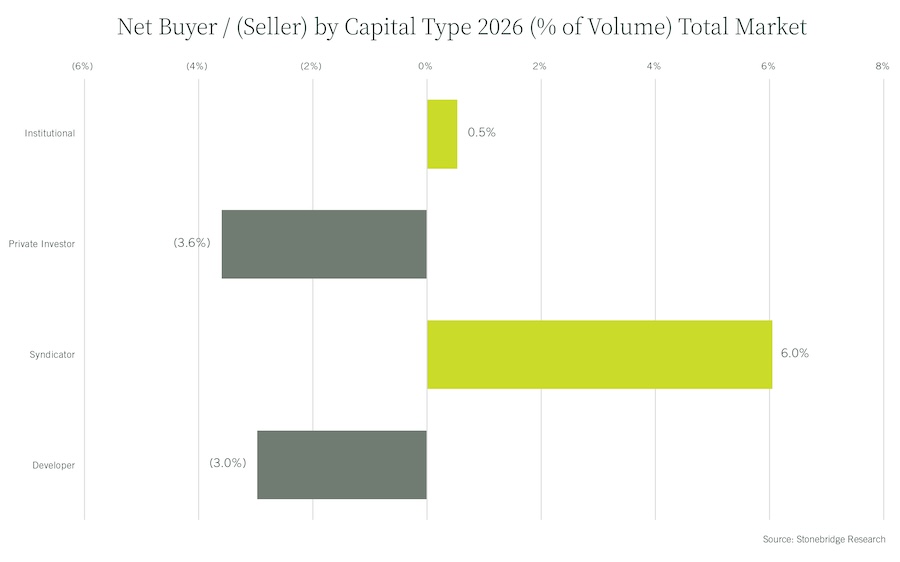
Off-market activity in 2026 has largely been driven by institutions trading assets with other institutions. Syndicators have been the only source of incremental demand, acting as net buyers of assets sold off-market by institutions and private owners. Private investors appear to be using off-market processes to exit, while their acquisitions remain primarily focused on on-market opportunities.
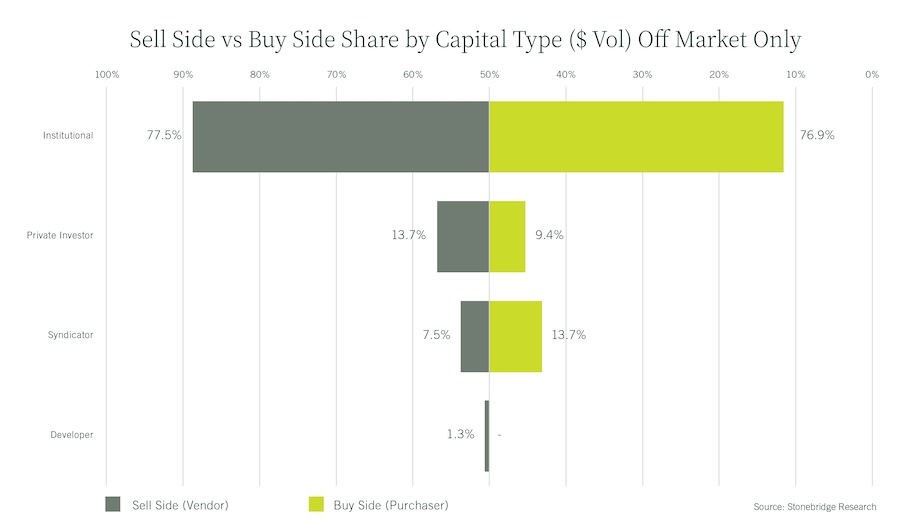
By value, institutional capital has overshadowed all other capital sources in off-market deals during 2026, reflecting the large-ticket and structured transactions undertaken by these groups (with a particular focus on regional shopping centres).
While institution-to-institution deals accounted for just 9 of the 28 off-market deals in 2026 (32 per cent of transactions), they represented some 73 per cent of total off-market volume. Ninety-four per cent of institutional sell-side volume went to another institution, whilst 95 per cent of institutional buy-side volume was sourced from another institution. In effect, capital is circulating within the institutional pool rather than entering or leaving it.
The rise in institutional off-market activity has also been supported by heightened transaction volumes in the larger Regional centre sub-sector, up 45 per cent on the prior five-year average. All other sub-sectors are either broadly in line with (neighbourhood centres, +4.3 per cent) or below their prior five-year averages.
Neighbourhood centres are the only other retail sub-sector to record transaction volumes above the prior five-year average. However, activity here has been concentrated in on-market transactions, reflecting the sub-sector’s large pool of private buyers, who typically prefer the transparency and certainty of an on-market campaign. Stonebridge Retail Investments transacted close to $1 billion of neighbourhood centre sales in FY26, around 39 per cent of national volume.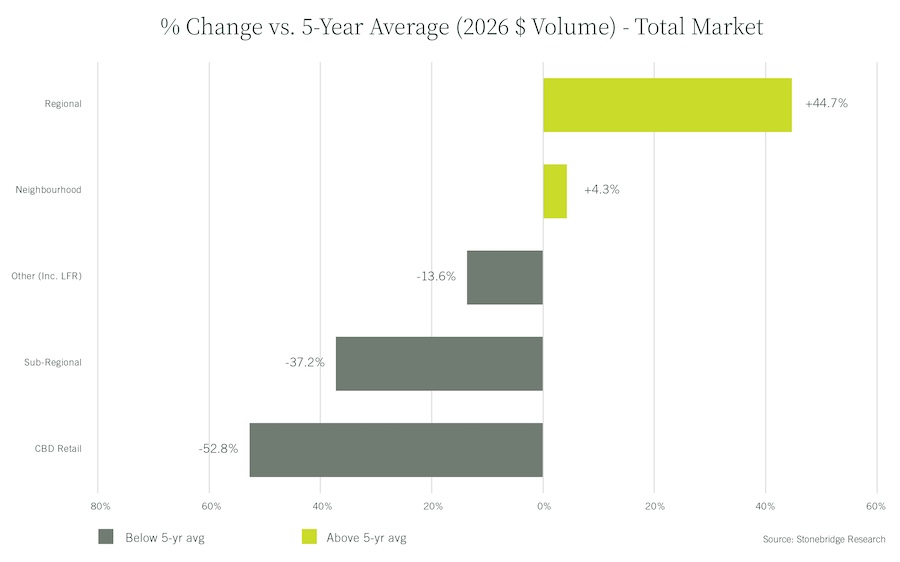
Syndicators the largest net buyer in 2026
Whilst syndicators have been priced out of much of the retail market in 2026 due to higher debt costs and competition from buyers with a lower cost of capital, they remained the only buyer type to hold a relatively strong net buyer position over the year.
This indicates continued growth among these groups, with few divestments despite rising debt costs in recent months. Many syndicators are positioning themselves as local managers for new entrant capital (particularly offshore), allowing them to remain active through the cycle with less need to raise traditional retail money from their high-net-worth investors. All other buyer types have been neutral or net sellers in 2026. Despite this, no capital source has shown a definitive shift or outlier result, further highlighting the depth of capital in the market and the evenly matched competition for new acquisitions.
Conclusion
2026 has highlighted the depth of capital competing for shopping centres, with an increasingly diverse buyer pool bolstered by a number of new entrant players, particularly offshore capital partnering with local managers. Notably, no capital source has been a major net buyer or seller of retail over the year, indicating almost equal competition across the board. Strong confidence in pricing, reflected in a yield differential of just 6bps between on- and off-market transactions, has underpinned a record year of off-market activity, with off-market deal share rising to 53.5 per cent.
Looking ahead, an increasingly volatile global environment and rising debt costs may begin to shift these capital dynamics. Should pricing confidence soften and bid-to-ask spreads widen, the current balance of competition is likely to change, which could create pockets of opportunity for well-capitalised and well-positioned buyers.




Add comment