

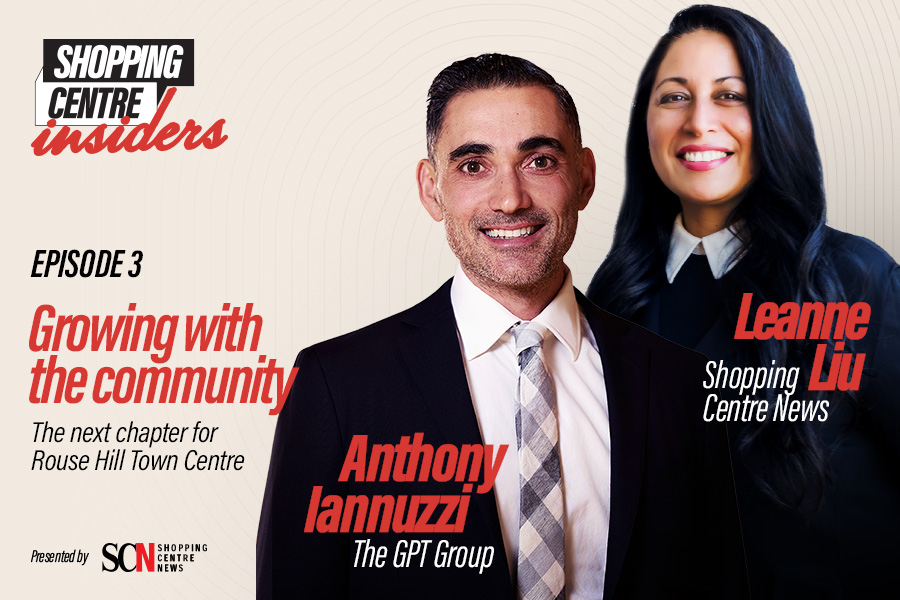

Rouse Hill Town Centre was conceived more than 20 years ago as an ambitious mixed-use town centre in what was then a largely undeveloped part of Sydney’s north-west. As the community around it has grown, GPT is now investing in its next chapter – using customer insight, retailer demand and a long-term masterplan to evolve the destination once again.
For Anthony Iannuzzi, Rouse Hill Town Centre has been part of his career almost from the beginning.
More than two decades ago, while working in retail, one of his first jobs was determining where signage would go on a brand new shopping centre being developed on Sydney’s metropolitan fringe.
At the time, the vision for Rouse Hill was ambitious: an open-air town centre integrating retail, residential, services and public spaces, centred around a main street and town square.
“Back then, the idea of having residential and retail mixed together in a main street that really started in a paddock was something that I certainly from the outside thought, well, that’s a nice dream, but not sure how they’re going to go,” Iannuzzi recalls.
Two decades later, the vision has not only endured – it has become one of the defining characteristics of Rouse Hill Town Centre.
What began as a town centre surrounded by farms and rural land now sits at the heart of one of Sydney’s fastest-growing corridors, with residential development, infrastructure and new services transforming the surrounding community.
For Iannuzzi, now Head of Development, Retail at The GPT Group, that evolution provides an important lesson for the industry: the most successful masterplans are not necessarily those that remain unchanged, but those with a strong enough vision to evolve alongside the communities they serve.
A vision that has grown with the community
The original Rouse Hill vision was built around the idea of creating a sustainable, integrated town centre, bringing together residential, retail and multiple uses around public spaces.
Today, Iannuzzi describes it as a “poster child” for mixed-use and residential retail development.
But its success, he says, comes down to the conviction behind the original masterplan.
“The main learning really is to stay true to that conviction and that vision that was set,” he says.
“It obviously needs to adapt as the market around us does, but that really active type management that we have and we do is what’s setting Rouse Hill up for its next phase of success.”
That evolution is increasingly visible in the community itself.
Twenty years ago, the centre primarily served households looking for convenience and everyday needs. Today, many of those original residents remain in the area, but their lives – and therefore their expectations of the town centre – have changed.
That changing customer profile is one of the drivers behind GPT’s current $200 million investment in Rouse Hill Town Centre.
The next stage will add more than 10,500 square metres of retail space and more than 50 new stores, strengthening the centre’s fashion, dining, lifestyle and services offer.
But this is not a traditional turnaround project.
Rouse Hill is already one of the most productive assets in GPT’s portfolio – and among Australia’s leading shopping centres by productivity – while retailers operating at the centre are actively seeking additional space.
For Iannuzzi, that creates a very different investment proposition.
“Rouse Hill really is, as you’ve just put it, us developing from a position of strength and really opportunity rather than being reactive,” he says.
The surrounding infrastructure investment has also reinforced the case for expansion, with a new Metro connection at the centre’s doorstep and a major new hospital under construction across the road.
“When you’ve got that coming out, you’ve got retailers asking you for space, you’ve got a growing catchment,” Iannuzzi says.
“For us, the timing and the investment from our side of things was right. It gelled with the macro themes that we could see, and also the data insights that we were able to get from both customers and retailers.”
That combination – a productive existing asset, growing demand and a long-term development vision – has allowed GPT to invest proactively rather than waiting for the centre to reach a point where reinvestment becomes necessary.
“When you’ve got a catchment that’s growing so fast beyond you, you need to stay relevant, and the best way to do that is to be on the front foot,” Iannuzzi says.
Where customer insight meets leasing
For a centre that has evolved alongside its community for two decades, understanding what customers want next has become central to the development process.
GPT has access to extensive data and insights, but Iannuzzi says the value comes from bringing different sources of information together rather than relying on any single measure.
At Rouse Hill, that includes direct engagement with customers, social media feedback, retailer conversations, leasing demand and broader catchment data.
The centre also has a highly engaged local customer base that GPT can regularly consult.
“We’re actually pulling together the questions and asking our customers who already shop there on a monthly or a fortnightly basis. We’re asking them and checking in with them,” he says.
That insight is then brought together with what the leasing and retail teams are seeing on the ground.
The result is helping shape not only which retailers come into the next stage, but how existing retailers can evolve.
Some businesses that have been at Rouse Hill since its early days have themselves grown alongside the community and now require larger spaces.
“A lot of what we’re doing in stage two for Rouse Hill is right-sizing those retailers who have grown with us, who have grown with the community,” Iannuzzi says.
The approach is deliberately analytical.
“Rather than just do a deal because there’s a deal to be done or put a tenant in because they’ve made a call, we actually do a fair degree of just analysing to go, are they going to be productive for us and are we going to be productive for them?”
For Iannuzzi, the role of data is ultimately to validate – rather than replace – property expertise.
“It’s probably validating the intuition and assumptions that everyone in property seems to have, but then how do you validate that with data so that we’re not just there sort of throwing darts in the wind?”
The value of getting place right from the beginning
While the retail mix will continue to evolve, Iannuzzi believes one of Rouse Hill’s greatest competitive advantages was established before the centre even opened: its open-air, community-focused design.
Main Street, Market Square and Town Square, together with the centre’s public spaces and connections to surrounding residential, commercial and medical uses, create a level of integration that can be difficult to replicate retrospectively.
“Rouse Hill is open-aired, Rouse Hill has a lot of public open space. Rouse Hill is connected to residential lobbies, to commercial suites, to medical,” he says.
“Those are things which we’re very fortunate to be benefiting from because of previous strategies and decisions.”
For an industry increasingly focused on placemaking, Iannuzzi believes there is a broader lesson.
“If I could ask to sprinkle something across our whole assets tomorrow, it would be just that,” he says.
The challenge is that creating authentic community spaces after the fact can be significantly harder than building them into the original vision.
“To try and then get the community to buy into that after the fact … it is really hard,” he says.
At Rouse Hill, those spaces have become part of the identity of the centre – providing customers with reasons to spend time there beyond shopping.
The Town Green and dining precincts, for example, offer spaces for people to gather, while Market Square provides an open-air arrival point from the Metro.
For Iannuzzi, that is a fundamental part of what makes Rouse Hill distinctive.
Investing before you need to
The Rouse Hill story also points to a broader issue facing Australia’s established shopping centre sector.
With limited new shopping centre supply coming to market, owners are increasingly looking at how existing assets can remain relevant and competitive as customer expectations change.
Iannuzzi argues that reinvestment should not necessarily mean making an asset bigger. It can be about ensuring the space that already exists remains desirable.
“It’s less around how much space you have and how good the space that you’ve got actually is,” he says.
The distinction, he believes, is between investing from a position of strength and investing because an asset has reached a point of need.
“Sitting around and waiting until it’s too late is probably the difference between what we were saying before when you’re investing out of a position of strength rather than maybe out of need or defence,” he says.
That philosophy also applies to masterplanning.
A long-term vision provides direction, but it cannot become a constraint.
“If you’re doing that you’re not as nimble and you’re not as adaptive to the market around you,” Iannuzzi says.
“Having a vision and, as you say, being cognisant of the market around you, that’s the important bit.”
For Rouse Hill, that means the next chapter is unlikely to be the final one.
Iannuzzi expects the story to continue evolving as the community grows and new needs emerge.
“The fact that the story’s still being written 20 years later will be a success for us,” he says.
“I feel like there’s a few more to come in that next 20 years.”
And if there is one principle he believes should sit at the centre of decision-making for owners and developers, it is the intersection of data, market demand and vision.
“Where they all intersect is where you’ll get alignment and you’ll get everyone focused and therefore you’ll get the best result,” he says.
“Every table needs four strong legs. So as long as you’re keeping all those legs strong and working on them all at the same time and not prioritising one over the other, I think you’ll get a really good outcome.”
For a town centre that began as a vision in a paddock more than 20 years ago, it is a fitting approach to its next chapter.
- Further reading: Growing with the North-West: Rouse Hill Town Centre expands


Add comment