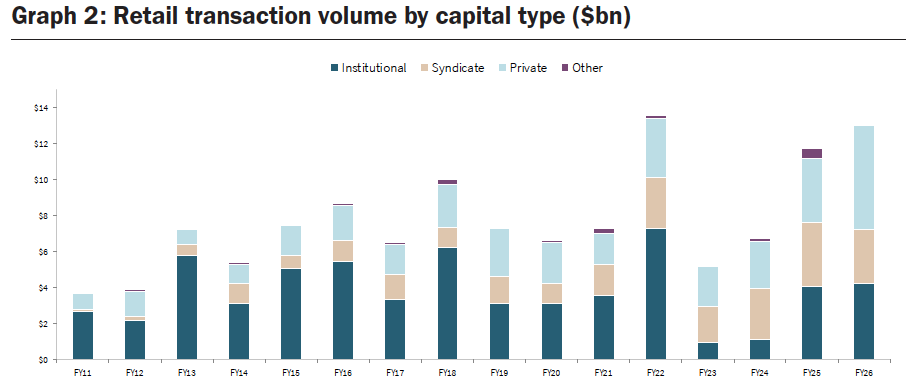
m a position of strength. The convergence of capital sources observed last financial year, with institutional, syndicator and private capital all competing on near-equal footing, has not only persisted but deepened. Over the year, retail property changed hands across every major sub-sector, sustaining the elevated activity established through the record 2025 calendar year and keeping the sector firmly at the front of investor attention.
What distinguishes FY26 is the depth and scale of the capital now engaging with the sector. Alongside the established domestic players, the year has seen a renewed appetite from major limited partners, including superannuation and wholesale funds domestically and global institutional capital abroad, re-weighting toward retail after a multi-year hiatus. This shift is not confined to Australia; it mirrors a global rotation back into retail that is visible in the United States, where retail has reclaimed its highest share of sector investment in a decade.
Retail leads the Australian commercial property sector
Retail property continues to attract investors on the strength of its fundamentals: population growth, positive leasing spreads, resilient income, and value underpinned by substantial, often irreplaceable, land holdings. Combined with the well-documented decline in retail floor space per capita and a structurally constrained development pipeline, these attributes are drawing capital toward retail and away from traditional office and industrial allocations.
FY26 confirmed retail’s position at the front of the market. At approximately $13.0 billion, retail outpaced both office (around $9.6 billion) and industrial (around $8.7 billion), making it the most actively traded of the three core commercial sectors. Retail accounted for roughly 42 per cent of the combined ~$31.3 billion transacted across the three sectors in FY26. Critically, this was no one-off: it marks the second consecutive year retail outsold both office and industrial, following FY25, the first time that had happened on record.
The shift marks a clear break from the prior cycle. Office dominated commercial transaction volumes for most of the past two decades, leading the market every year through to FY20, and since 2010 an additional $85 billion of capital had been directed toward the office sector. That position is now unwinding as investors rebalance toward retail’s income resilience, positive leasing spreads and the value underpinned by often irreplaceable land holdings.
“Major capital sources are re-weighting back toward retail after a sustained period of outperformance, and Australia is firmly part of that global shift and a standout for the Asia Pacific region. Capital depth is now at every level, with wholesale and listed institutions, offshore groups, syndicators and private investors all actively engaged across the various sub-sectors. This demand is being met with limited investment supply pipeline and is driving an increase in partial interest transactions and formation of new partnerships – a trend we expect to continue to build for the remainder of the year” – Nick Willis, Executive Director, Retail Investments, Australia & New Zealand, JLL
Capital demand deepens, and scale becomes the new currency
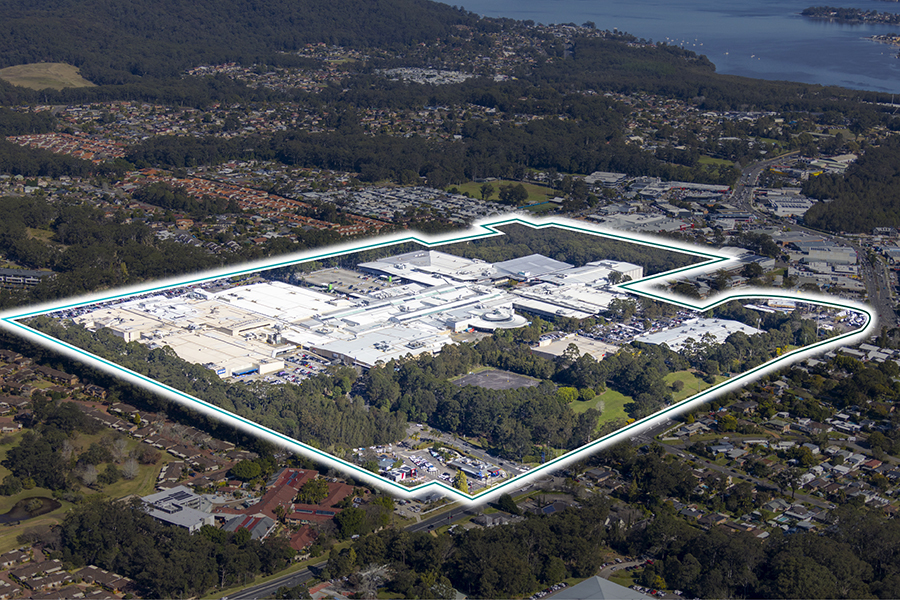
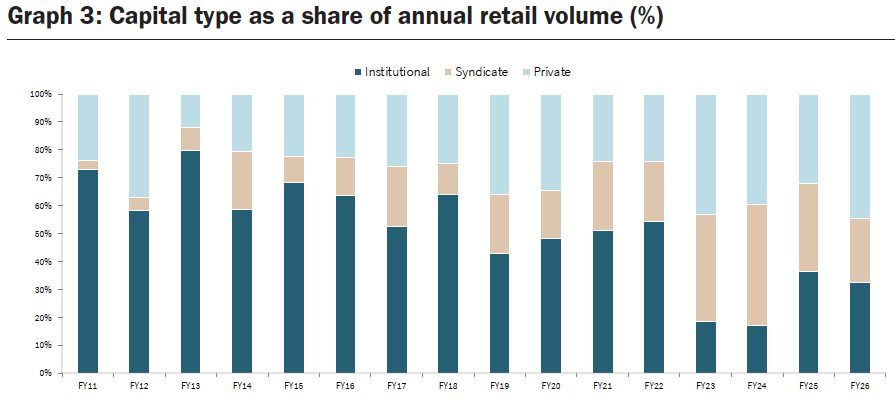
Retail in Australia was historically dominated by institutional and private capital. Since 2017 the landscape has shifted, with syndicators acquiring progressively larger assets and lifting their market share. Fawkner Property Group’s $895 million acquisition of Erina Fair, the year’s largest single-asset retail transaction (on a 100 per cent basis), is a prime example of a syndicator stepping up. That convergence, with institutional, syndicator and private capital competing on near-equal terms, reached a high-water mark in FY25 and has held firm through FY26.
Through the year, competition increasingly centred on assets of scale. The average retail deal size climbed to approximately $124 million across the priced transactions, with 29 individual transactions of $100 million or more and 13 exceeding $300 million. That is the highest annual average on record and roughly 66 per cent above the FY25 average of about $75 million, underscoring how decisively activity has shifted toward assets of scale. Investors’ preference for operational efficiency and irreplaceable land is creating a genuine size premium, with the best-of-the-best assets drawing the deepest bidder pools.
The net positions tell the story clearly. Institutional capital was again a substantial net divestor, selling more than $10 billion of retail as groups such as Scentre Group (SCG) and Lendlease (LLC) continued to recycle and reposition portfolios, yet it remained highly active on the buy side, acquiring more than $4 billion, much of it through wholesale funds. Private capital was the standout net acquirer (+$4.3 billion), while syndicators continued their structural rise (+$2.2 billion), increasingly partnering with institutions on larger assets.
“Competition for retail assets has been exceptional, with bidder participation well above the levels of two or three years ago. To secure scarce, high-quality assets with management, capital sources are sharpening terms and moving faster. With major investors re-entering the sector in Australia and offshore, that competitive intensity looks set to persist” – Sam Hatcher, Head of Retail Investments, Australia & New Zealand, JLL
FY26 net buyers and sellers
As in FY25, several institutional groups appeared on both the buyer and seller lists in FY26, finalising divestment programs in one fund while deploying through another. This active portfolio management, selling mature or non-core assets and recycling capital into scale opportunities, has been a defining feature of the year, and is a key reason institutions remained one of the most active buyers by dollar value, acquiring more than $4 billion, despite being the largest net sellers.
Private investors were again, the backbone of the market. They were the most active capital source by deal count, completing 64 of the 105 priced FY26 transactions (61 per cent), and accounted for 44 per cent of acquisitions by value, the single largest share. Their consistency, particularly across the neighbourhood and convenience segments, continues to underpin liquidity at the lower end of the market even as headline volumes are driven by a handful of large deals.
Private capital’s long-run stability remains evident. Over the past decade private investors have accounted for roughly 48 per cent of all retail transactions by deal count (around 30 per cent by value), averaging close to 60 deals a year. Their activity barely changes from one year to the next, holding remarkably steady through the cycle, whereas institutional and syndicate volumes swing far more sharply with conditions.
Where is buy-side capital participating in FY26?
The sub-sector weightings reveal a clear division of capital. Regional centres, the largest and most liquid, dominated volumes, accounting for roughly $5.6 billion, or around 43 per cent of FY26 activity. That represents a striking resurgence. As recently as FY21 regional assets barely registered, yet they now command their largest market share in more than fifteen years. Sub-regional and neighbourhood assets followed, while CBD retail showed early signs of recovery on the back of returning workers and tourism.
That competition has repriced the Regional sub-sector. Equivalent yields on regional centres have compressed by roughly 160 basis points, from an average of about 7.46 per cent in FY23 to 5.84 per cent in FY26, with core regional assets now trading below 6 per cent. That repricing is a clear signal that institutional and wholesale capital has re-entered the large end of the market in force.
Institutional capital
Institutional capital remained the key driver of the largest transactions, led by local wholesale funds and selective offshore groups deploying directly or via joint-venture and pooled structures. The standout feature of FY26 was the prevalence of partial-interest acquisitions at the top end of the market, a structural response to the scarcity of assets that allowed groups to gain or retain exposure to irreplaceable centres.
Notable examples include:
GPT Wholesale Fund’s acquisitions of 50 per cent interests in Sunshine Plaza ($622m) and Macarthur Square ($568m)
Dexus Wholesale Fund’s Westfield Chermside tranches (2 x 25 per cent, $683m each)
Australian Retirement Trust’s 19.9 per cent stake in Westfield Sydney ($864m)
JY Group acquisition of 50 per cent in Westfield Marion ($670m)
Partial shares above $200 million now meaningfully outnumber 100 per cent opportunities of comparable scale. Partial-interest deals accounted for around 36 per cent of transaction volume, and a record ~$4.6 billion changed hands in partial stakes of $200 million or more, well above the prior peak of roughly $2.7 billion in FY25.
A global capital story
The re-weighting toward retail is a global phenomenon, and the intelligence flowing back from offshore markets is directly relevant to Australia. In the United States, retail has reclaimed its highest share of sector investment in a decade, with trailing 12-month volumes reaching roughly US$62 billion, up around 31 per cent year-on-year, and institutional investors now comprising close to a quarter of all retail investment.
Yields in the United States have already started to compress, with the spread between grocery-anchored and power centres narrowing from around 160 basis points to roughly 50. For capital now studying and bidding for Australian retail, that points to the likely direction of travel here. That appetite is already visible on the ground: in June, Morgan Stanley partnered with Stockland on a JLL-advised portfolio of convenience-based centres, an early and tangible example of global institutional capital moving directly into the Australian market.
Conclusion
FY26 confirms that the capital convergence of recent years has matured into something broader and more durable. Institutions are recycling and redeploying at scale, syndicators are moving decisively up the size curve, and private capital continues to provide the market’s ballast, all while a new wave of major investors, at home and abroad, re-engages with the sector. With the supply pipeline structurally constrained and global capital increasingly focused on Australian retail, the competition for scarce, high-quality assets shows no sign of easing. FY27 is shaping up to be defined less by whether capital returns to retail, and more by how it gains access to a market with too few assets to satisfy it.
This article prepared by James Hayward, Senior Analyst, Retail Investments, Australia & New Zealand, JLL is featured in the latest issue of SCN magazine




Add comment