This CEO Outlook contribution was first published in SCN Vol. 39 No. 1, Big Guns 2021 No doubt we’re all glad to see the back of 2020. But despite lockdowns and economic hurdles, the COVID-19 pandemic helped us to see the underlying strength of the retail sector. Last year showed us that the foundations and drivers for retail remain strong. That is, consumers’ desires for experience, connection and community, has continued to drive visitations to shopping centres and retail precincts. The p
andemic has also highlighted the extent of human impact on the environment as people travelled less and lived local, and this came after a summer of unprecedented drought and severe bushfires.
The imperative to act to limit climate change has never been stronger.
Delivering environmental and social outcomes, alongside financial, have been hallmarks of Lendlease since our inception – and continue to be cornerstones of our company globally. In the midst of the pandemic, we announced our most ambitious climate change targets.
The climate change challenge
We know the world is at an environmental tipping point and we face a harsh reality: either we continue as we are, and irreparably damage our planet, or we come together and agree ambitious steps to prevent its catastrophic warming.
Climate change is already significantly impacting our natural and built environment. Due to the amount of greenhouse gases in the environment, the planet has already warmed by 1°C. If we continue to do nothing, the planet will warm by over 4°C, which will catastrophically impact our ecosystems, lives and livelihoods.
If we fail to act as individuals and organisations, we could well see more conflict between nations as countries look inwards in the face of increasing extreme weather events and skyrocketing food prices as crop yields are impacted. Global supply chains may contract further, creating tougher economic pressures, compounded by escalating heat waves, flood and storm surges around the world and that will force mass migration to safer countries and areas.
These events will hit our business, like it will hit our competitors and companies like us. Our scenario testing shows that the costs to the retail sector of doing nothing will be significant – costs such as those related to carbon emissions, supply chain disruptions, disaster recovery, energy costs and insurance premiums.
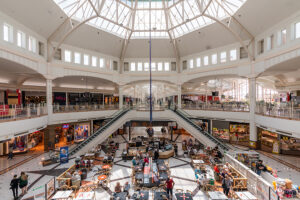
Lendlease has been investing in upgrades to its shopping centres, including on-site solar to drive energy efficiency
Sustainability makes business sense
The good news is the partnerships, technologies and skills needed to make a real difference already exist or are in development. And addressing sustainability in the context of the built environment makes business sense.
Most of us are aware of the demographic shifts driving structural changes in the sector. Millennials and Gen Z already make up half the world’s population and financially, we’re about to see significant wealth transfer over the next ten to 30 years. According to a recent Deloitte report, the financial figure is tipped to be close to $30 trillion.
With these generations soon to dominate the workforce and hold the greatest share of spending power, what will be their preferences and how will they spend their time and money? Our research predicts that these younger generations will value time, experience and purpose over buying the latest shoes, watch or handbag. They see the wider impact of everything they do and that includes where they spend their money. They’re buying less but spending more on brands or companies they know are ethical and sustainable.
About 42% of Millennials and Gen Zs surveyed by Deloitte said they would ‘start’ or ‘deepen’ their access to products and services that clearly had a positive impact on the environment and society. About 38% surveyed said they would stop association with products and services which had a negative impact.
As they start entering the workforce, Millennials and Gen Z will aspire to work for companies that are proven to be environmentally and socially responsible – companies that will help them fulfil their desire for a higher purpose.
And it’s not just consumers and workers, we’re seeing increasing demand and interest among investors and stakeholders in highly sustainable companies and assets. For our sector, driving sustainability outcomes will protect and create value for retail assets.
Delivering environmental and social outcomes, alongside financial, have been hallmarks of Lendlease
Taking the lead
For these reasons and because it’s the right thing to do, Lendlease announced in August 2020 our most ambitious climate change targets. We’re now a 1.5ºC aligned company with a commitment to achieving ‘Net Zero Carbon’ for scope 1 and 2 emissions by 2025 and ‘Absolute Zero Carbon’ across all operations, including the supply chain, by 2040.
We know our targets are ambitious by industry standards, and it’s not going to be easy to reach them. But we’re an organisation with significant influence and a large global footprint. And we’re in a good starting position to achieve them.
We again topped the GRESB Real Estate Assessment in 2020, with our retail funds taking out the top three positions in the Australian and New Zealand peer group.
For more than a decade, Lendlease has been investing in upgrades to our shopping centres, including on-site solar to drive energy efficiency, along with a focus on driving operational improvements in the areas of water efficiency and waste minimisation.
Over the next few years, we’ll be enacting a decarbonisation investment strategy and phasing out the use of diesel and gas. We’ve set a deadline for converting to 100% renewable electricity before 2030. Most importantly, we’ll be collaborating with our supply chain partners and tenants to transition to zero carbon by 2040.
Making a difference together
Lendlease’s commitment to achieving our ambitious targets must be matched with a collective focus from the sector, in order to truly make a difference to climate change and minimise impacts to our businesses.
Together, we have the political and economic capital to call for stronger policies, investment and action from policy-makers in government and industry.
As a start, to address the impact of climate change on industry supply chains, we should significantly increase investment in industry-led research and development on incentive mechanisms to drive zero carbon transport solutions and local manufacturing, including zero carbon materials for the construction industry.
We should focus research and development on climate resilient buildings and infrastructure, and develop incentives, such as lower contributions and government funding, to stimulate private investment in this area.
Policy and regulation updates for buildings need to be reviewed to include design parameters for future climatic conditions, rather than what is currently the norm, historic climate conditions.
Globally, we need to establish market-based mechanisms to lift poor performing assets and set minimum performance standards for existing and new developments.
Lendlease have set a deadline for converting to 100% renewable electricity before 2030
Shopping centres of the future
If these policies were put in place to drive industry transformation, what could a shopping centre of the future look like?
In 2050, we imagine we’d see shopping centres generating more energy and harvesting more water than they need for their operations, with any surplus energy and water exported to adjacent communities and buildings.
We’ll see highly efficient solar panels across all shopping centre roof tops, rainwater tanks harvesting rainwater and green spaces interspersed throughout the centre to cool down the environment naturally and provide recreational spaces for customers. There may be mini-farms where retailers can harvest produce while supporting local biodiversity.
The centre would be passive designed to reduce reliance on heating and cooling plant equipment.
Expect to see centre furniture and shop fit-outs to be constructed out of sustainable materials and all waste generated on-site to be recycled, reused or converted to energy instead of being sent to landfill.
We’ll be sharing our sustainability data live to customers and retailers in much more immersive and sensory ways. Retailers will market their sustainable products and credentials to customers through newly created and seamless channels.
Back of house, we’ll see the use of technology monitoring building efficiency and automatically adapting the building to conditions. An avalanche of data will be generated and rapidly analysed by AI to help the centre meet customer and retailer needs. These are just some of the things we can foresee but we’re only bound by our imaginations.
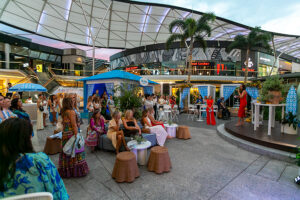
Sunshine Plaza, Queensland
The year ahead
With less than five years left to reach net zero carbon in our operations, this year Lendlease will be focused on setting ourselves up to meet this ambitious target.
As a sector, we’ll continue to be challenged by COVID-19 until effective vaccines are successfully rolled out nationwide. Because the trends we were grappling with before the pandemic have only accelerated, we expect to see the industry rapidly scale up its efforts to evolve shopping centres to be more experience-centred and mixed use.
We expect to see most industry players ramp up their investment in technology this year, with a focus on generating and analysing customer data to help shopping centres make quick decisions and adapt to changing consumer needs, providing customers with seamless and easy digital engagement with centres and ensuring operational efficiency.
While we’re all focused on transforming our assets and investing in technology, this is also the prime opportunity to put sustainability at the centre of our planning and development.





Add comment