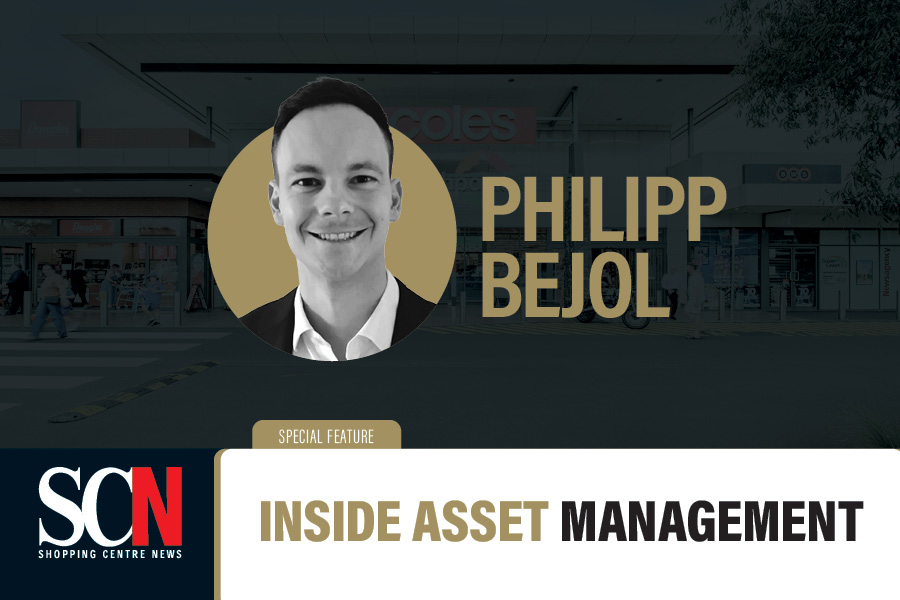
Philipp Bejol’s career has taken him from development and asset management in Germany to investment analysis and retail asset management in Australia. Now part of IFM Investors’ retail portfolio team, he works across neighbourhood, sub-regional and CBD assets, including the InterContinental Brisbane. Here, Philipp discusses navigating an increasingly uncertain retail environment, the importance of disciplined long-term thinking and why curiosity, listening and collaboration remain critical t
o successful asset management.
Shopping Centre News (SCN): How did you get started in retail property, and how has your career evolved?
Philipp Bejol (PB): My career in retail property started in Germany with Unibail-Rodamco-Westfield, where I joined as a graduate and gained my first exposure to asset management. From there, I moved into the Development team, working on a major brownfield mixed-use project in Hamburg. It was an excellent introduction to the broader development and mixed-use landscape.
After moving to Australia in 2019, I took up a role at AMP Capital as investment analyst, working across the retail portfolio with a focus on Queensland. This gave me a strong analytical foundation. I then became increasingly interested in having greater involvement in the decisions that directly influence an asset’s performance.
An opportunity subsequently came up with ISPT, which has since become part of IFM Investors, to join its asset management team in Brisbane. More than five years later, the role has allowed me to build on my analytical and development background while becoming much more involved in the strategy, performance and day-to-day realities of managing retail assets.
SCN: What types of assets do you currently manage and what are your priorities?
PB: Within IFM’s retail portfolio team, I work across neighbourhood, sub-regional and CBD shopping centres, including the InterContinental Brisbane. It is a diverse portfolio, with assets at different stages of their lifecycle, from relatively stable centres through to assets undergoing development or repositioning, and with a broad mix of retailers and customer profiles.
InterContinental Brisbane
SCN: What projects, initiatives or achievements have been the most rewarding throughout your career?
PB: The most memorable experiences in my career have generally been those where I have been part of a team that is passionate, driven and committed to achieving a common goal. There is something particularly rewarding about seeing an idea progress from the early stages through to a tangible outcome.
Obtaining development approval for Westfield Hamburg-Überseequartier, in Germany, was a milestone early in my career. Being involved in that process gave me a good appreciation of the complexities of major projects and the huge amount of collaboration that is required.
More recently, I have been involved in the repositioning and minor extension of a neighbourhood centre on the Sunshine Coast. It was the result of successfully executing an acquisition strategy and then working with the whole team to deliver on the investment thesis.
SCN: What do you enjoy most about asset management, and what continues to motivate you?
PB: The variety is probably what I enjoy most. No two assets, two days or two challenges are quite the same, and there is always something new to learn.
Retail portfolio asset management interacts with so many different disciplines, departments and stakeholders. You work with a wide range of people, each bringing different experiences and perspectives.
That combination of variety, learning and collaboration keeps therole interesting.
Northpoint, QLD
SCN: How has the role of an asset manager changed over the past five years?
PB: We are operating in a world of ever greater uncertainty, which increasingly feels like a constant rather than the exception. At the same time, change is happening faster, particularly in retail, with consumer behaviours and trends evolving very quickly.
That means asset managers need to be adaptable and think carefully about resilience and future-proofing. However, I also think there is value in occasionally tuning out the noise and focusing on the long-term objectives. We do not necessarily need to respond to every new trend. Rather, our approach is guided by disciplined analysis and a focus on initiatives that we believe support long-term value creation for investors.
SCN: What metrics do you look at beyond sales and occupancy when measuring the success of a centre?
PB: I would look at metrics such as foot traffic, dwell time, customer frequency and the overall quality of the experience. These can help us understand how customers are using and engaging with a centre.
The quality and diversity of the retailer mix and how well the centre is meeting the needs of its catchment are also important.
Ultimately, a successful centre should have strong financial performance, and, equally, it should remain relevant to the community it serves. I find that in practice, the two reinforce each other over the long-term.
SCN: What are the most significant opportunities currently emerging across the retail property sector?
PB: It is an exciting time to be in retail. We are seeing renewed interest from capital in this asset class, which I have not experienced to this extent in my career so far. Over the last couple of years, the retail sector has undergone a rebalancing of rents, cap rates and ultimately asset values. That adjustment is now creating attractive opportunities for capital.
There is also increasing competition, particularly from institutional investors, for neighbourhood centres. The defensive nature of non-discretionary-focused assets is one factor driving this interest, particularly in an environment of greater uncertainty.
Northshore Marketplace, QLD
SCN: How do you build strong, long-term relationships with retailers and other stakeholders?
PB: For me, it comes down to trust and integrity. I try to be genuinely interested in understanding the other party’s perspective, needs and objectives, rather than approaching every conversation from my own position.
Consistency is also important. Strong relationships are built over time by communicating openly, doing what you say you will do and being prepared to work through difficulties constructively.
Ultimately, good outcomes are usually achieved when people feel they are working towards a shared objective rather than negotiating against each other.
SCN: Many retail assets are evolving into broader community and mixed-use destinations. How is that changing the asset management function?
PB: In my view, it requires asset managers to look beyond the traditional retail environment. As centres become more integrated with the community and various uses, it is important to think more holistically about how an asset functions and how people experience it.
That requires innovative thinking and a willingness to take a long-term view. Some opportunities to evolve an asset may take considerable time and involve complexity. The best options may not always be immediately obvious, and they can require us to bring together people and expertise from outside the traditional retail property environment.
SCN: What qualities do you think make an exceptional retail asset manager?
PB: Curiosity is very important. Retail is constantly evolving, and there is always more to understand, whether that is changing customer behaviour, retailer strategies, development opportunities or the broader market. Having the willingness to keep learning is invaluable.
The ability to listen is equally vital. There is a huge amount to learn from the people around you, whether that means retailers, customers, other team members, an investor or a consultant.
Finally, collaboration is critical. An effective asset manager needs to bring people together, navigate different perspectives and create an environment where everyone is working towards the same outcome.
SCN: What advice would you give to someone starting a career in retail asset management today?
PB: Stay curious and take the time to understand how all the different parts of an asset fit together. Asset management sits at the intersection of many disciplines and stakeholders, so there is a lot to learn from the people around you.
Listen more than you speak, particularly early in your career. There is a lot to learn simply by observing how experienced people approach different situations.
I would also encourage people to be comfortable with not having all the answers. Retail is constantly changing, and being adaptable and willing to learn is more valuable than having a perfect response every time.
This Q&A with Philipp Bejol forms part of the Inside Asset Management feature published in the latest issue of SCN magazine





Add comment